Sunday, 31 October 2010
Audrey recommends
The FT's Philip Stephens has a well-judged post on the proposed reforms to the NHS. It is a few days old now, but doesn't go out of date that fast! It is well worth a read and poses the question on many people's minds: why?


Saturday, 23 October 2010
Plus ҫa change
This Spectator blog post gave me a strong sense of deja vu - Cameron is a leader somewhat apart from the mainstream of his party taking a bold course of action in the face of a lack of international consensus on what should be done, and at the same time morally absolutely certain that he is right to do it.
Plus ҫa change...
Plus ҫa change...
Thursday, 21 October 2010
Spending Cuts: a couple of observations

2. The security and intelligence services see a 6.6% decrease. This is risky considering the continued high terrorist threat to the UK - the Prime Minister will be called to account if there is a terrorist attack on the mainland that, arguably, could have been prevented. Of course we would never know if it could have been prevented with an extra bit of money or not, but it would be a very uncomfortable time for the PM nonetheless.
By the way, this table over at the FT is very handy indeed.
Friday, 15 October 2010
NHS Atlas of Risk
 This tool is fascinating! It tells you what are the things that are most likely to kill you - and puts into perspective all the newspaper warnings about allergies, chemicals etc. Highly interesting and will definitely make me eat more vegetables.
 What I found scary was personalising it to 'Female' and 'age 20-44' and then out of curiosity changing the sex to 'Male' - the 2nd cause of death suddenly becomes suicide, in a great big grey circle. It is easy to forget how big an issue this is for young men.
The second scary thing was adding that I'm in London - suddenly the murder circle got bigger!
Ed's First PMQs - or Dr Cameron and Mr Brown
This is late, I know, but I have to comment on this week's Prime Minister's Questions.
When pressed on child benefits, David Cameron's answer was basically that Ed had no alternative policy on deficit reduction. He didn't answer the question or acknowledge that some people will lose out (as some always will when policies are changed), so his good points about the less well-off paying taxes to fund child benefit and the deficit being paid off had no impact.
This sort of argument is depressingly familiar - it used to be Gordon Brown's favourite line when challenged by David Cameron at PMQs : 'he has no policy on the economy...' It was weak then, and it's weak now. I earnestly hope that Cameron isn't going to turn into Brown at PMQs and that his team will prepare him better for next week.
My advice: be human and honest. Accept that there will be some losers and the policy isn't perfect, then people will actually listen when you go on to explain that those on low incomes should not be taxed to help middle income families look after their children. How to deal with the losers is a problem: means testing is not practicable. Either promise to look into it if you are prepared to compensate them, or accept that it just can't be helped.
When pressed on child benefits, David Cameron's answer was basically that Ed had no alternative policy on deficit reduction. He didn't answer the question or acknowledge that some people will lose out (as some always will when policies are changed), so his good points about the less well-off paying taxes to fund child benefit and the deficit being paid off had no impact.
This sort of argument is depressingly familiar - it used to be Gordon Brown's favourite line when challenged by David Cameron at PMQs : 'he has no policy on the economy...' It was weak then, and it's weak now. I earnestly hope that Cameron isn't going to turn into Brown at PMQs and that his team will prepare him better for next week.
My advice: be human and honest. Accept that there will be some losers and the policy isn't perfect, then people will actually listen when you go on to explain that those on low incomes should not be taxed to help middle income families look after their children. How to deal with the losers is a problem: means testing is not practicable. Either promise to look into it if you are prepared to compensate them, or accept that it just can't be helped.
Tuesday, 12 October 2010
The Role of Shadow Chancellor
 The commentariat is divided: one side thinks Alan Johnson's background and political skill make him a worthy opponent to George Osborne, the other side thinks his lack of knowledge and expertise in economics put him at a disadvantage.
As usual, there is some truth in both points. The defining political argument of our times is about the economy and Labour need to present a cogent alternative to the government if they are to win over voters. A Shadow Chancellor who understands economics would seem to be a good idea.
And yet...
In opposition, the trump card is not subject matter expertise but political skill and acumen - the Opposition can play politics when it is to their advantage, it is one of the benefits of their position and allows them to boil their arguments down to a couple of key points or criticisms. They do not have to have a fully fleshed out alternative policy (as Cameron proved by winning the election!)
A further point, that so far does not seem to have been aired, is that the Shadow Chancellor is not the key person to put forward Labour's economic case - that role falls to the Leader of the Opposition as the foremost figure in the party. Naturally enough, opposition parties don't get as much media attention and find it hard to set the agenda (this is a disadvantage of opposition). The leader therefore tends to do most of the running and despite Alan Johnson being a known figure this will still be the case here. Ed Miliband as the new leader also needs to boost his public profile and convince people that he is a potential Prime Minister. Given the country's situation he must do this on one key battlefield - the economy. His Shadow Chancellor will provide back-up. And that is a role Alan Johnson is perfect for.
Sunday, 10 October 2010
Seen at Conference

- Iain Duncan Smith surrounded by young ladies who seemed very pleased to see him.
- Toby Young, author of How to Lose Friends & Alienate People, and one of a group of parents behind the West London Free School project, lurking at the back of a fringe meeting on autonomy in schools with his sunglasses on through the whole meeting!
- Menzies Campbell sitting in an inconspicuous corridor of the conference centre, just before the footbridge to the Hyatt Hotel - I would say he also was lurking, but he looks far too distinguished to lurk.
- Eric Pickles holding court with the media.
- Fraser Nelson, Editor of the Spectator, generally looking dishy.
- Tony Blair's autobiography in the conference bookshop, heavily discounted already.
- Jeremy Paxman looking (surprisingly) old - or perhaps just very worn out by all the conference-ing.


Wednesday, 6 October 2010
Cameron's Speech: National Interest vs Self Interest
 This is what stood out for me in Cameron's speech to the Conservative Conference today. He was clear that his party is acting in the national interest, as is Nick Clegg's, and in his call to the public to join in the work - to volunteer, set up a business, engage with their public services etc. Together in the National Interest - the words were said so many times it was almost too much, but that is how to get a message across (we can all learn from Brown on that point).
Of course the unsaid comparison is with the Labour party - the party of vested interests (the unions) that acted against the national interest (the large public debt the country now has) and even, in Ed Miliband, perhaps a selfish leader? A man who sacrificed his brother for his own ambition and who is 'too busy' to put his name on his child's birth certificate?
A clear message then, but are the voters listening? I can't wait for the next polls to come out.
Getting Business Going

I suggest a few policy areas that need some serious attention to help with this:
1) Transport - investment in the country's transport infrastructure is vital for business; lots of cancelled projects will cause jitters (possible - Transport Secretary Philip Hammond understands this)
2) Planning - this doesn't just affect the housing industry. If you are a foreign investor and you need to build a factory or plant, the uncertainty and cost of the planning process in the UK is a disincentive (not likely)
3) Energy - a big sector in its own right and also part of the UK infrastructure. We need a big 'Invest Here and Now' sign to be put up by the Department of Energy and Climate Change (not likely)
4) Tax - some moves have already been made on this; they should be shouted from the rooftops over and over again to ensure everyone gets the message that the UK is a good place to do business (likely)
5) Regulation - the cost to business of regulation is gigantic and while not adding to it is a good start, government could also look at simplifying or cutting back on some of what is there already. (not likely)
Teaching Unions - Clever Words?
At the previously mentioned meeting I attended on school autonomy, Christine Blower of the NUT said something that I think is highly important for the coalition government and Michael Gove. She described public sector schools as 'community schools'. This very deliberate and brazen attempt to hijack the term for schools where parents only get a say if they are one of a few to join the governing board, and then find they have almost no room for manoeuvre anyway, is in its own way quite brilliant. And it contrasts with the government's own poor communications on the issue.
This redefinition of the public sector to mean the same thing as community confirms David Cameron's point that the left seems to think that the state and society are the same thing. Ideologically debatable, but in communications terms it's a great move - cutting through the government's attempt to differentiate between communities' interest and that of the public sector that serves them, boosting the 'fluffy' factor of the public sector schools and trying to paint the government's plans as being against rather than for local communities.
This boldness with language and messages goes to show just how tough the union opposition to the coalition's plans will be for Michael Gove to overcome.
This redefinition of the public sector to mean the same thing as community confirms David Cameron's point that the left seems to think that the state and society are the same thing. Ideologically debatable, but in communications terms it's a great move - cutting through the government's attempt to differentiate between communities' interest and that of the public sector that serves them, boosting the 'fluffy' factor of the public sector schools and trying to paint the government's plans as being against rather than for local communities.
This boldness with language and messages goes to show just how tough the union opposition to the coalition's plans will be for Michael Gove to overcome.
Audrey recommends
 This post from Alistair Campbell is excellent - he clearly tells us what No.10 is doing wrong in its communications and tactics on the child benefit issue.
It seems to me (and the polls confirm) that most sensible people agree with the policy and its aims, but a completely unnecessary fuss has been created due to poor communications.
Schools - mission impossible?
I am just returned from the Conservative Party Conference in Birmingham - more on that later. The thinktank Policy Exchange held a meeting on whether school autonomy would improve school performance. The single point that struck me most forcefully was made by a Swedish 'free schools' expert, Anders Hultin, who argued that although politicians needed to leave the 'how' of education to teachers, pupils and parents, there is absolutely a need for political leadership in defining what education IS - the 'what' question.
Teachers, heads, parents and children need to know what they are striving for and aiming at - what is their mission? It has been discussed elsewhere that the previous Labour government widened the purpose of schools from educating children to reducing inequalities, improving health and other social purposes. Some argue that a focused remit on excellent education for children would yield better results. This thinking goes down well with Conservatives, particularly those of a traditional bent.
 So far so good. However at another meeting sponsored by the RSA and this time on the topic of the Big Society, the point was made that if the government wishes to encourage people to be active in their communities, schools are essential points of interaction. This is particularly so in very deprived communities where structured charitable and social organisations are rare.
So - in pursuing the Department for Education's core mission, the role of schools as lightning rods of the Big Society might well be undermined. Those two strands of current Conservative thinking seem to clash in a way that highlights the contradictions between the traditional wing of the party and the leadership's more 'progressive' tendencies. Political leadership will be needed to address this and make a choice if schools are to understand what their mission is. After all, that is what leadership is for.
Teachers, heads, parents and children need to know what they are striving for and aiming at - what is their mission? It has been discussed elsewhere that the previous Labour government widened the purpose of schools from educating children to reducing inequalities, improving health and other social purposes. Some argue that a focused remit on excellent education for children would yield better results. This thinking goes down well with Conservatives, particularly those of a traditional bent.

So - in pursuing the Department for Education's core mission, the role of schools as lightning rods of the Big Society might well be undermined. Those two strands of current Conservative thinking seem to clash in a way that highlights the contradictions between the traditional wing of the party and the leadership's more 'progressive' tendencies. Political leadership will be needed to address this and make a choice if schools are to understand what their mission is. After all, that is what leadership is for.
Friday, 1 October 2010
Trimming the Quangocracy
I was sceptical that the new government would be able to make much headway with its promise of a 'bonfire of the quangos'. Vested interests grow up around such bodies and every single one, I thought, would defend itself with vigour.
Instead the process has been remarkably quiet, with consultations and discussions taking place within Whitehall rather than causing much public fuss. A list of 177 bodies, agencies, committees and quangos to be abolished has now emerged at the Telegraph, along with two other lists: a list of bodies still under review and a list of bodies to be merged.

Two things strike me:
First, the astonishing number of advisory committees, which I'm certain are completely ignored when their advice isn't what the Minister wants to hear. I don't think this means their expert advice will no longer be heard - rather the opposite, they were muffled inside the tent and now they can speak loudly and openly. Scientists may need a bit of help lobbying government in the right language, the right way and at the right time (as do businesses) but setting them loose from government itself may prove to be a good thing in the long run.
Second, the cuts under consideration go much further than I thought they would. Even executive agencies such as the Environment Agency are still under review for example - this would be a very big move. The EA was formed in 1996 by a Conservative government and employs over 10,000 staff. I rather suspect this one will be merged or moved into the Department almost wholesale. But the point is that nothing has been taken for granted, it really has been a root-and-branch review.
I applaud the effort and believe this is a worthwhile exercise. However, much like the cuts to the Building Schools for the Future programme, I hope the people in charge have done their homework properly and aren't rushing things...
Instead the process has been remarkably quiet, with consultations and discussions taking place within Whitehall rather than causing much public fuss. A list of 177 bodies, agencies, committees and quangos to be abolished has now emerged at the Telegraph, along with two other lists: a list of bodies still under review and a list of bodies to be merged.

Two things strike me:
First, the astonishing number of advisory committees, which I'm certain are completely ignored when their advice isn't what the Minister wants to hear. I don't think this means their expert advice will no longer be heard - rather the opposite, they were muffled inside the tent and now they can speak loudly and openly. Scientists may need a bit of help lobbying government in the right language, the right way and at the right time (as do businesses) but setting them loose from government itself may prove to be a good thing in the long run.
Second, the cuts under consideration go much further than I thought they would. Even executive agencies such as the Environment Agency are still under review for example - this would be a very big move. The EA was formed in 1996 by a Conservative government and employs over 10,000 staff. I rather suspect this one will be merged or moved into the Department almost wholesale. But the point is that nothing has been taken for granted, it really has been a root-and-branch review.
I applaud the effort and believe this is a worthwhile exercise. However, much like the cuts to the Building Schools for the Future programme, I hope the people in charge have done their homework properly and aren't rushing things...
Thursday, 30 September 2010
How the public sector voted
I'm just catching up with Ipsos Mori's Labour Conference briefing pack. An interesting fact on page 12, which I had not appreciated before, is that only 34% of public sector workers voted Labour in the 2010 General Election, compared to 46% in 2001 and 52% in 1997.
Given the Conservatives' clear message about cuts, I find this surprising. What do you think?
Given the Conservatives' clear message about cuts, I find this surprising. What do you think?
Communicating on the voters' priorities
The coalition wants to talk about spending cuts and reform of the public services, especially education and the NHS. Its narrative, as many others have pointed out, is not yet clear and compelling.
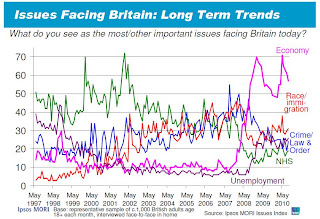
However, the Economist (11th September issue) points out that for the public, the overwhelmingly most important issue facing Britain is the economy - concern about the NHS and education is at its lowest point for 25 years, having started to decline as important issues from 2002. Their source is IPSOS Mori. The Economist removed immigration and unemployment from their graph for clarity, but the full one is still interesting:

So, what does this mean for the Conservatives and Liberal Democrats in the coalition government? That as well as communicating their narrative effectively, they need 'a plan for growth' to be part of that narrative, exactly as Ed Miliband and Ed Balls have been pointing out. The government needs to show it understands people's concerns for their jobs and the state of the economy, and that they are doing what they can to help. Measures announced in the Emergency Budget have already been forgotten and could do with being repeated ad nauseam. What else? Well, often, the best thing the government can do for business is to get out of its way! So deregulation or streamlining how regulations work would help take some of the burden off business without spending much public money.
Which reminds me of Reagan's famous quote on the government view of the economy: 'if it moves, tax it, if it still moves, regulate it, if it stops moving, subsidise it'!
Ed Miliband
Over the last couple of days I have heard Ed Miliband say 'as the leader of the party, I...' several times. He sounds slightly unsure or incredulous at his own position and I would advise him to change his language so that he simply assumes the authority of leader without referring to it. He would come across as a bit stronger and more confident.
Tuesday, 28 September 2010
Is Whitehall Listening to Business?
 A couple of years ago there were mutterings that BIS might be abolished altogether should the Conservatives come to power. Certainly pre-Mandelson it was widely viewed as not up to much. Mandelson's political power and proximity to the PM changed that. With its destiny so closely linked to its Secretary of State, what is Cable's anti-business stance doing for the department's role within Whitehall?
How can the department champion business while its Secretary of State criticises capitalism en masse? How can it retain credibility with either side - business or government? I understand that Vince Cable 'doesn't believe in sectors' when it comes to the department's work. That is mind-boggling, and leaves civil service teams supporting particular sectors nowhere.
In this situation, the 'back-up' that BIS represents to big business' relationships with government is no longer what it once was (though many were already sceptical of its ability to influence colleagues in Whitehall). This can present specific problems for some, where the departments they engage with are unreceptive and need encouragement to consider business issues as part of their agenda. A more creative use of wider communications tools will be needed to open up some of those attitudes; the same messages from the same people should not be expected to change matters.
For smaller business, the BIS situation is a much bigger problem as they find access elsewhere in Whitehall much more difficult. For them, trade bodies will be the key to such access and they should invest their time in making such collaborative efforts work. Success may also require smaller businesses to put pressure on their trade bodies to up their game in communications and public affairs and, indeed, their general leadership.
Friday, 24 September 2010
A lesson from Eurostar
 |
| Image from the Sydney Morning Herald, who sourced it from AFP |
Customer services were only open 9 'til 5, as if nothing had happened, and so were virtually uncontactable. Eventually, it was the company's Facebook page that came to the rescue. Hundreds of people had joined it - ironically making them 'fans' of Eurostar - and someone started to answer their queries. As many of these were very similar, people could read previous answers and find useful information. Users also helped each other by passing on information from staff at the main terminals (on both sides of the Channel). Slowly confusions were cleared up and people helped. A 15 year old girl alone in Brussels was successfully repatriated - with Eurostar's efforts in full view of hundreds of customers looking at the page.
It wasn't at all perfect (answers from Eurostar tended to come at 2 or 3 hour intervals), but a PR tool intended for no such thing had suddenly become the only responsive customer service channel available.
Ever since, I have offered this example to colleagues, employers and now potential employers in my interviews as an illustration that customer relations and corporate communications should be linked up. Customers need to be considered part of the communications team's remit as intimate stakeholders of the organisation (I don't say 'key' stakeholders because the word is overused).
Customer relations teams may be unhappy about this and see it as a land-grab by Comms Directors. I don't think this needs to be the case - Comms teams are well used to working in partnership with internal colleagues and a great deal could be achieved simply by establishing relationships and working together.
Wednesday, 22 September 2010
An Early Christmas Song from the Lib Dems
See this Spectator post for an amusing Lib Dem song - who says Lib Dem Conference is dull?
Monday, 9 August 2010
What is happening to policy making?
The processes that supposedly underpin policy making in this coalition government appear to have completely broken down during the summer break. The milk 'U-turn' and graduate tax double 'U-turn' are cases in point - Ministers and No.10 are completely unco-ordinated, ideas are being floated willy-nilly only to be slapped down only to be resurrected.
This is pandemonium!
The country needs better government than this; I hope things calm down ahead of the Spending Review. The government appears to be campaigning rather than governing and we risk the same 'non-debate' over spending cuts that we had during the election.
Subscribe to:
Posts (Atom)